Sales and Operations Planning

Sales and operations planning is the monthly process where sales, production and finance agree on one number for what you will sell and make. This page explains what S&OP software actually does, when the spreadsheet is still the right tool, what it costs, and why forecast accuracy is the wrong first target.

What is sales and operations planning?

Sales and operations planning (S&OP) is the monthly cycle where demand and supply agree on one plan: what you expect to sell, what you can make, and how you close the gap.

It is not standard operating procedures. The plan relies on data from your CRM, ERP and floor, and pulling it together by hand is the job most tools replace.

What S&OP software actually does

The parts that matter in a mid-market business, as opposed to the parts that sell enterprise planning suites.

One set of numbers

Demand, supply, stock and capacity in one place, built from the source systems rather than assembled by hand. Most of the value is here, before any forecasting happens.

A statistical baseline

History-based forecasting as a starting point, so the discussion is about where to override the baseline rather than about what the baseline should be. Nobody defends a number they typed if the system produced a reasonable one first.

Capturing the overrides

Sales knows about the promotion and the tender; the model does not. What matters is recording who changed a number and why, because that record is what makes the next cycle better.

Supply and capacity

What you can actually make with the lines, people and materials available. A demand plan nobody has tested against capacity is a wish list.

Scenarios

What happens if the big customer doubles their order, or a line goes down for a fortnight. Useful once the base plan is trusted, and a distraction before then.

The part that is not software

S&OP is a meeting with a decision at the end of it. If nobody in the room can commit the business to the plan, better numbers change nothing — the tool makes a working process faster, it does not create one.

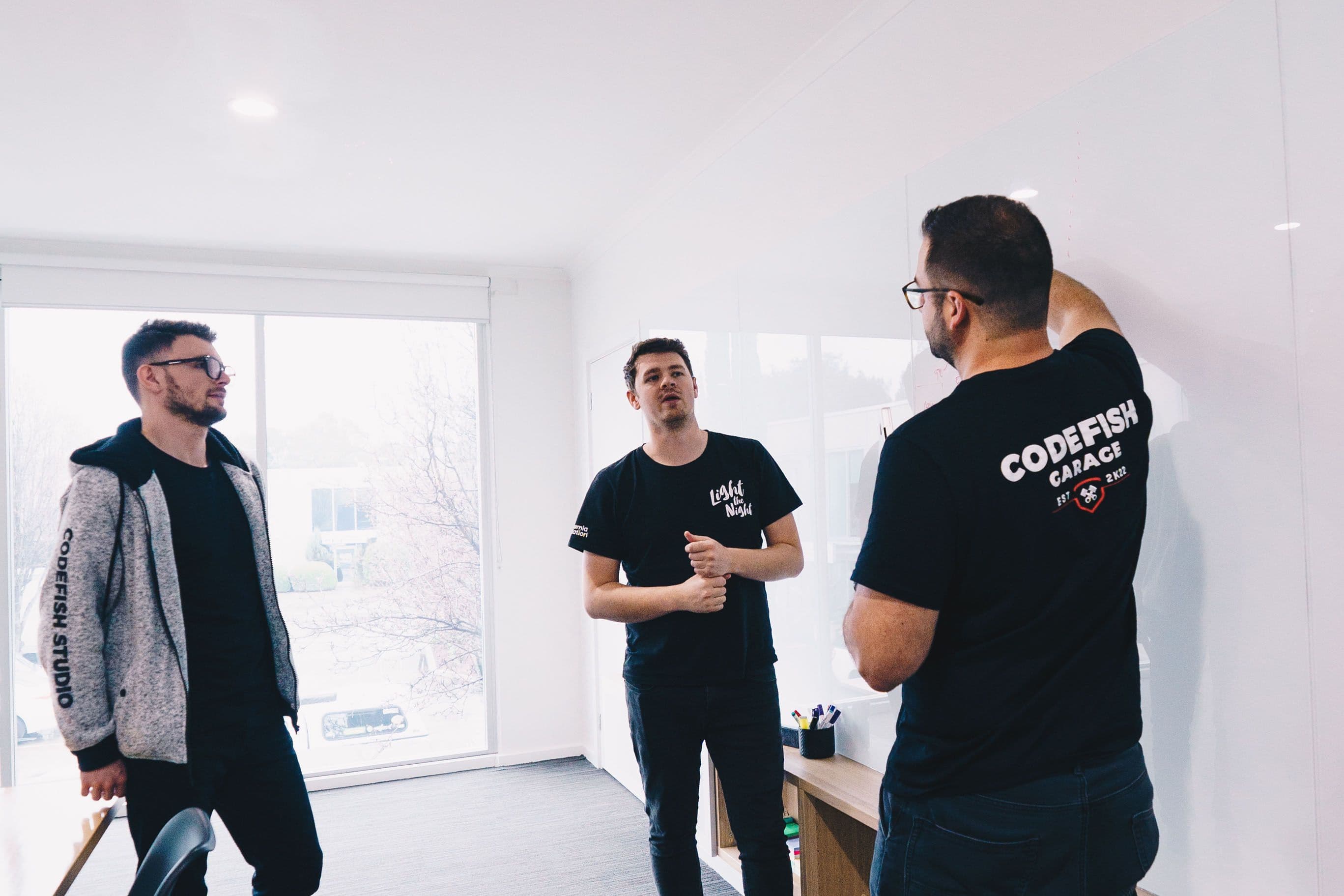
Three team members in CodeFish shirts talking in a whiteboard scoping session

Keep the spreadsheet, or replace it?

Keep the spreadsheet while it is small enough to check and one person can explain every number. Replacing a working one is a costly mistake.

Replace it when assembly outgrows analysis, or only one person understands it. The usual answer is not a planning platform. Automate the assembly into one view and leave the judgement with your people.

Sales has a number. Production has a different one. Both are defended monthly, in a meeting.

What does S&OP software cost?

Cost follows your source systems and how clean their data is.

Start with a $9,000 workshop

Fixed $9,000 + GST. We sit in your planning cycle and time how much goes on assembling data. The roadmap is yours either way.

Source systems

Cost is driven by how many systems the plan draws on and how clean their data is.

Product code clean-up

If product codes differ between systems, reconciling them is the first piece of work. Know this before you budget.

Amplify or Apex

A defined scope is fixed-price as Amplify. Apex suits planning, because the process changes as the business grows.

How a planning project runs

Sit in the cycle (2–4 weeks)

We follow one full planning cycle: where the numbers come from, where they are argued over, and how long the assembly takes. It has to be a real cycle rather than a description of one, because the two are never the same.

Two CodeFish team members in discussion across a meeting room table, one taking notes

Automate the assembly (4–8 weeks)

One trustworthy view built from the source systems, replacing the copy-and-paste. The planner checks it against their own spreadsheet for a cycle or two, and the spreadsheet retires when the numbers agree.

A CodeFish developer working across three monitors, reviewing code and version history

Then improve the plan

Baseline forecasting, scenarios and accuracy tracking come after the data is trusted. Adding forecasting to numbers nobody believes produces a more sophisticated argument, not a better plan.

Four CodeFish team members working through a problem around a table of laptops, CodeFish Studio sign on the wall

Planning questions we get asked

No, and the shared abbreviation causes real confusion. Sales and operations planning is a monthly cycle that agrees demand and supply. Standard operating procedures are documented instructions for how work is done. This page is about the first one; the process side sits closer to our workflow and automation work.

It can improve it, but forecast accuracy is usually the wrong first target. A forecast that is consistently wrong in a known direction is more useful than one that is unpredictably close, because you can plan around a known bias. Start by measuring accuracy honestly and recording who overrode what — the pattern in the overrides tells you more than a better algorithm will.

Rarely, at mid-market volumes. Statistical methods that have existed for decades handle most demand patterns well, and they have the advantage that a planner can understand why the number moved. Machine learning earns its place with long histories, many SKUs and real seasonality — and it still needs someone able to explain its output in the meeting.

Someone senior enough to commit the business to the plan, which usually rules out the planner who assembles it. The most common failure is a well-run cycle producing a plan that sales and production both quietly ignore, because nobody in the room had the authority to make it binding.

Two to three years is comfortable; one year is workable if the business has not changed much. What matters more than volume is consistency — if product codes were restructured eighteen months ago, the history either needs mapping or it starts from the restructure. That mapping is often the first piece of work.

Four to eight weeks after the workshop for the assembly piece, which is where the hours are. The forecasting and scenario work comes later and delivers less than people expect — the month is lost to collecting data, not to thinking about it.

Ready to build something great?

Local partners, global standards – full service design and development.