Ai For Business

AI and Automation for Business

AI and automation pay off when they take a slow, manual job off your team. Find that job, prove it on your own data, then build it so it stays private and gets used.

Where AI and automation actually pay off in your business

A dense tangle of coloured computer cables and connectors

Start with the job, not the hype

Re-keying data between systems, chasing approvals by email, rebuilding the same report every week: this is work software should be doing. Some of it needs plain automation with clear rules. Some of it needs AI, because it involves reading, judging or answering.

Most projects stall because they start with the technology instead of a problem worth solving. We start the other way around: find the task that is slow, manual or expensive, prove it works on something small, then build it properly, private to your data and safe to rely on. Not sure where you sit? Our AI readiness quiz is a five-minute gut-check.
Where does AI do a real job?

One recurring task at a time, each tied to a number: hours returned, errors cut, or cost removed.

Reading documents

Invoices, dockets, purchase orders and certificates read and keyed in automatically, with a person checking the ones it is unsure about.

Checking against rules

Claims, orders and forms checked against your rules before they move on, so errors are caught at the start instead of at month end.

Answering from your records

Staff ask a question in plain words and get an answer from your own documents and systems, with the source shown, not a guess.

Forecasting

Demand, stock and workload predicted from the history you already hold, so planning starts from a number rather than a hunch.

How an AI project runs

Find the real use case

A readiness assessment separates the tasks where AI pays off from the ones where it is a gimmick, and tells you honestly if the answer is 'not yet.'

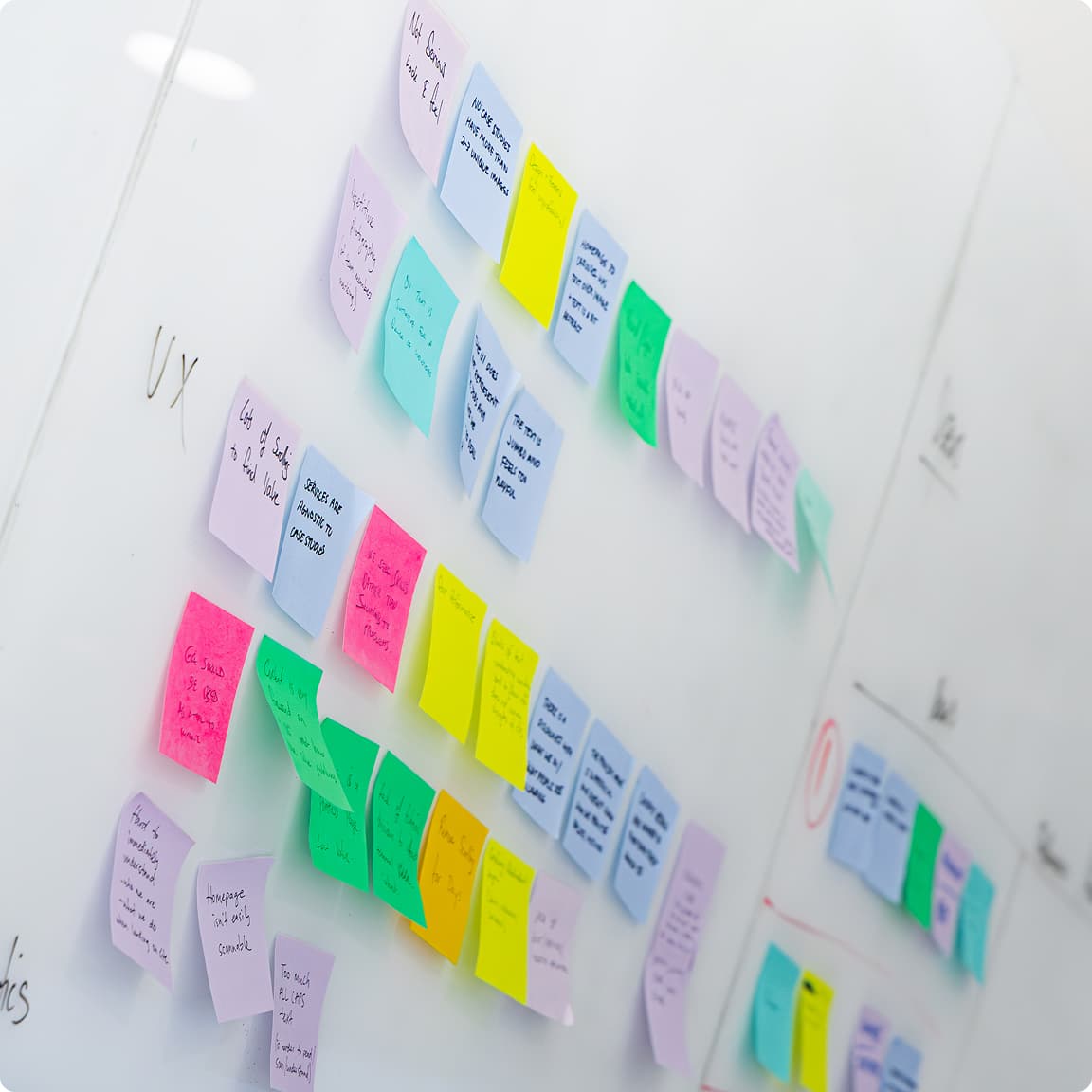
A whiteboard covered in colour-coded sticky notes from a UX workshop

Prove it with a POC

A small, time-boxed proof-of-concept on your own data. Real output you can judge before committing to a full build.

A CodeFish developer working across three monitors, reviewing code and version history

Build it in, safely

We ship it into the workflow with your data kept private and the guardrails to trust it. You own the system and the IP.

Two CodeFish team members in discussion across a meeting room table, one taking notes

What does an AI project cost?

Every project is priced before work starts.

Find the job

A Rapid Insight Workshop at a fixed $9,000 + GST maps where AI pays off in your operation and gives you a costed scope to take anywhere.

Prove it

A proof of concept through Ignite typically costs $25,000 to $50,000, built on your own data so you can judge real output before committing.

Build it in

A full build through Amplify starts from around $100,000 and is quoted fixed price. Running costs (usage, monitoring and review time) are agreed up front.

AI questions we get asked

Readiness is less about technology and more about whether you have a clear task and clean-enough data to point it at. Our five-minute quiz gives you a fast read, and a full readiness assessment goes deeper, including telling you when the honest answer is 'fix the process first, add AI later.'

Off-the-shelf tools are great for general, low-stakes tasks and you should use them where they fit. Custom is worth it when the job depends on your own data, has to plug into your systems, or can't send information to a public tool. Often the right answer is a mix, and the assessment is where we work out which is which.

This is the first question, not the last. AI can be built so your data never leaves an environment you control and is never used to train someone else's model. For Australian businesses with privacy or compliance obligations, that architecture is a design decision we make up front.

An LLM is a model that predicts and generates language, useful for reading, writing, summarising, and classifying text. RAG (retrieval-augmented generation) is the technique of feeding that model your own trusted documents at question time, so it answers from your data instead of guessing. Together they are what most practical business AI is built on today.

An agent on a single well-scoped job typically reaches production in six to twelve weeks. Where the data underneath has to be sorted out first, that work comes before the build and is scoped separately, so the timeline you are quoted is the real one.

It will sometimes, so the system is designed for it. A person keeps the decisions where being wrong is expensive or can't be undone, anything the AI is unsure about goes to a person, and its output is checked against what a good result looks like, the same way you would review a new starter.

Anywhere the cost of a wrong answer is higher than the cost of a person doing the job, and anywhere the process is still changing week to week. Fix the process first, then automate the stable part. A readiness assessment tells you which tasks fall where.

Ready to build something great?

Local partners, global standards – full service design and development.