Field Service Management

Field service management software gets the right person to the right job with the right information, and gets the record back without a phone call. This page explains what it covers, when an off-the-shelf product fits, what it costs an Australian operator, and why the mobile app decides whether any of it works.

What is field service management?

Field service management software schedules and dispatches work to people outside your building. It gives them what they need on the job and brings the record back: work done, parts used, sign-off and time.

Without it, jobs go out by phone and paperwork comes back at week's end. Invoicing waits, and so does knowing if the job made money. It connects to your CRM, ERP, warehouse and maintenance systems. Builders should also see construction job management software.


What field service software actually does

Ordered by what an operator usually feels first.

Scheduling and dispatch

Who is going where, visible to everyone rather than held by the person with the whiteboard. The immediate win is that the office can answer 'when will someone be there' without making two phone calls.

The job on a phone

Job details, site history, safety documents and the forms to complete, on the device already in their pocket. Everything else on this list depends on the technician actually using this.

Capture in the field

What was done, time on site, parts used, photos, signature. Captured at the job it takes two minutes; captured from memory on Friday it is fiction with a signature attached.

Parts and stock in vans

What each vehicle is carrying and what came off it. Van stock is the inventory most businesses have written off knowing about, and it is often a substantial number.

Straight to invoice

Completed jobs reaching the ERP the same day rather than at the end of the week. This is usually where the return is — days off the invoicing cycle, on every job.

What decides the outcome

Whether the app works with no signal. Technicians work in basements, plant rooms and paddocks. An app that needs a connection gets abandoned on the first job where it fails, and it never gets a second chance.

Buy a field service product, or build one?

Buy where the work is standard: scheduled visits, a job sheet, a signature, an invoice. If the demo runs end to end without customisation, that is your answer.

Build when the job is unusual, or when five years of per-technician licences cost more than owning it. Often the answer is both: a product for dispatch, a custom app for capture. Just keep one schedule.

The job is done. The paperwork gets back to the office three days later, if it does.

What does field service software cost?

The mobile app drives cost more than scheduling does.

Start with a $9,000 workshop

We spend a day in a vehicle, follow jobs and measure the lag between finishing work and invoicing it.

The field app drives cost

Offline use, the number of forms, and photos and signatures set the effort. This is the part that decides if the system gets used.

Scheduling is simpler

Scheduling and dispatch take comparatively little effort next to the mobile app.

Amplify, then Apex

A defined scope is a fixed-price Amplify project. New job types and compliance forms keep coming, so ongoing work suits Apex.

How a field service project runs

Go out with a crew (1 week)

A day in the vehicle, watching how jobs actually get dispatched, done and written up. Every field business has workarounds nobody in the office knows about, and they are always the reason the last system failed.

Two CodeFish team members in discussion across a meeting room table, one taking notes

Build the field app first (4–8 weeks)

The technician's app before the office's scheduling screen, working offline from day one. If the field half does not get used, the office half has nothing to schedule against.

A CodeFish developer working across three monitors, reviewing code and version history

Close the loop to invoicing

Completed jobs flowing to the ERP the same day. This is the step that turns a better-organised field team into a measurable cash-flow result, and it is where the project pays for itself.

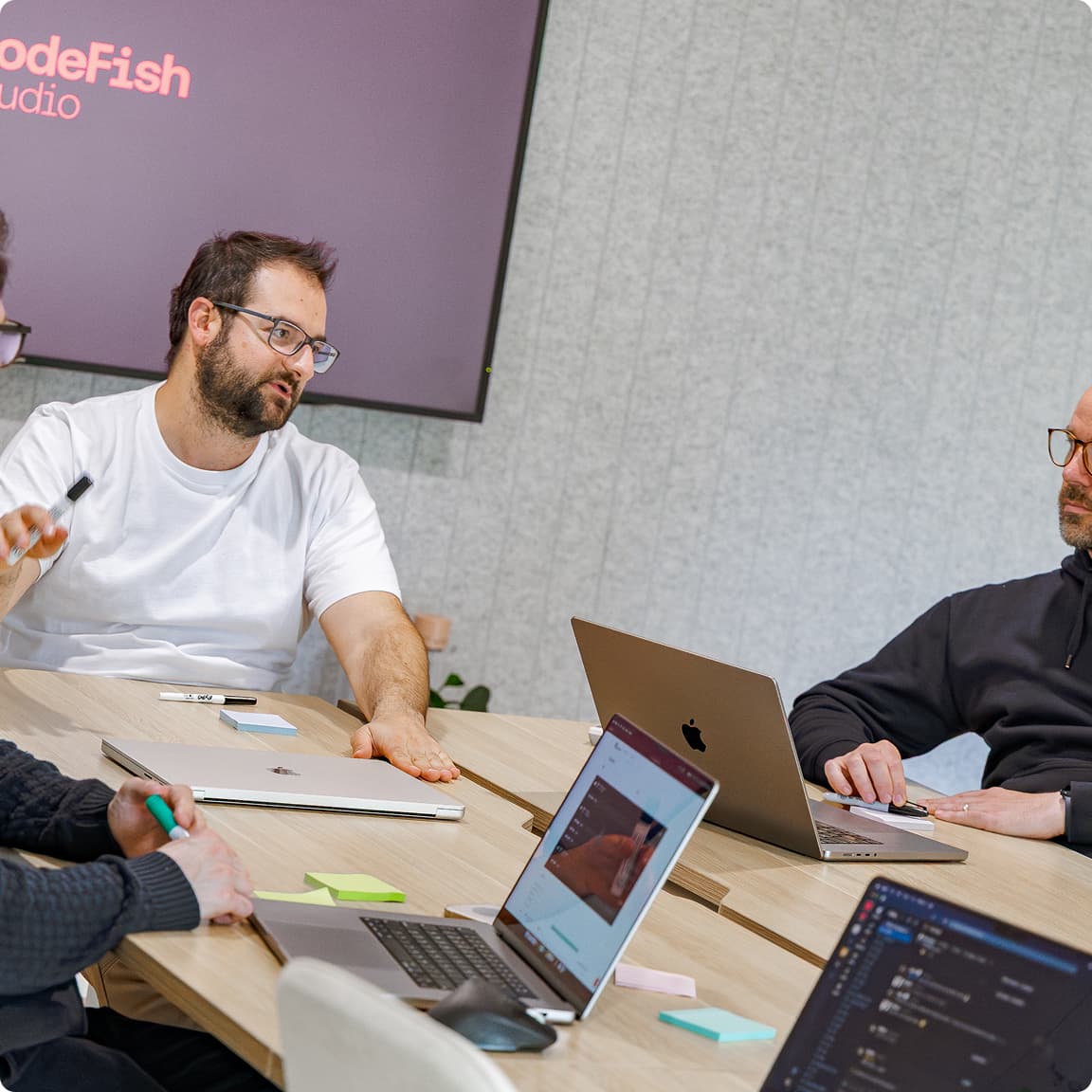
Four CodeFish team members working through a problem around a table of laptops, CodeFish Studio sign on the wall

Field service questions we get asked

They will use one that saves them time, and they have all used a phone for a decade. The failures come from apps that ask for more than the paper did — twelve fields where the docket had four, a login typed with dirty hands. Design the job for two minutes at the vehicle and adoption looks after itself.

The app has to work anyway, and this is not negotiable. Jobs get downloaded ahead of time, work is captured locally, and everything syncs when coverage returns. An app that needs a connection gets abandoned the first time it fails in a plant room, and no amount of training brings it back.

Buy if a demo runs end to end without anyone saying 'we would customise that'. Build when the job carries compliance forms specific to your industry, unusual pricing, or a customer mandating their own paperwork. A hybrid is common — product for scheduling, custom capture for the part that is genuinely yours.

Treat each vehicle as a stock location. Parts get issued to the van, consumed against a job, and replenished from what the job records. Most operators find the value tied up in vans is larger than they assumed, and it is the fastest inventory win once jobs are being captured properly.

Same-day is realistic where the job data flows to the ERP automatically, against a typical starting point of three to ten days. That is the number to build the business case on — it is cash flow rather than efficiency, and it is measurable from your existing data before you spend anything.

At first, deliberately. We digitise what you do before changing it, so the field team learns one new thing rather than two. Optimisation — routing, capacity, automated assignment — comes once there is real data about how long jobs actually take, which nobody has before the app is running.

Ready to build something great?

Local partners, global standards – full service design and development.