

Every business we work with has one. A spreadsheet that started as a quick fix five years ago and now runs something important.
In a food plant it tracks batches and allergens. On a building site it is the variations register. In a factory it is the production schedule that someone rebuilds every Friday afternoon.
It works. Mostly. And because it works, nobody puts a cost on it. So let us do that.
Count the hours
Start with the time. Ask who touches the spreadsheet and how long they spend on it each week. Include the copying in from other systems, the checking, the chasing people for updates, and the fixing when something breaks.
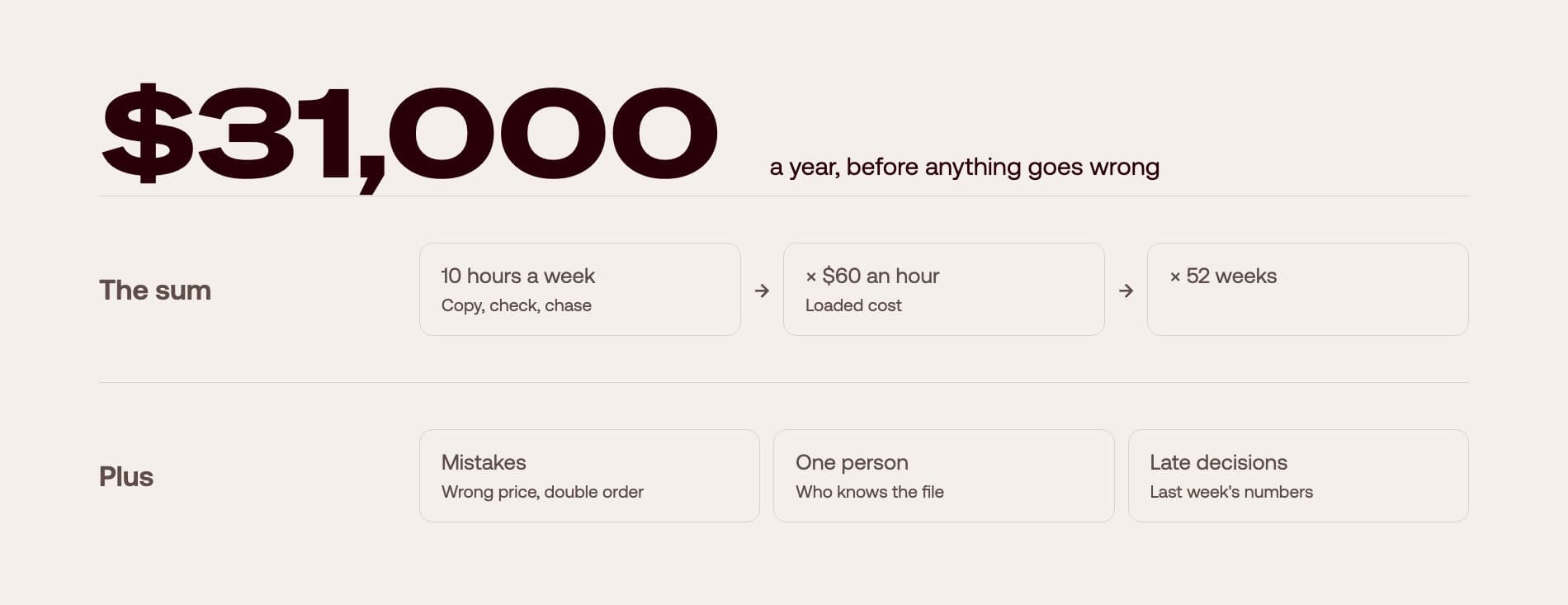
In most businesses we look at, it lands somewhere between five and 20 hours a week across a team. At a loaded cost of $60 an hour, 10 hours a week is about $31,000 a year. For one spreadsheet.
That is before anything goes wrong.
Count the mistakes
Spreadsheets do not warn you when a formula breaks. A row gets pasted over, a range stops one line short, and the totals still look fine.
Ask your team for the last time a spreadsheet error cost you money. A quote sent at the wrong price. Stock ordered twice. A variation never billed. Most people can name one straight away, and they usually know roughly what it cost.
Count the person
The biggest risk is not in the file. It is in the head of the one person who understands it.
When they are on leave, things slow down. When they leave for good, you find out how much of your business was running on their memory. We have seen companies hold off on growth for months because nobody else could safely change the schedule.
The cost you cannot see
A spreadsheet also hides what is going on. The data is there, but it is stuck in one file, on one laptop, a week out of date. You cannot easily see trends, spot problems early, or hand it to an AI tool and ask a useful question.
That is the hidden cost. Not just the hours, but the decisions you make late or blind because the numbers were not ready.
You do not have to replace everything
The answer is rarely a big new system. Often it is a small web app that does exactly what the spreadsheet does, with the parts that hurt taken out.
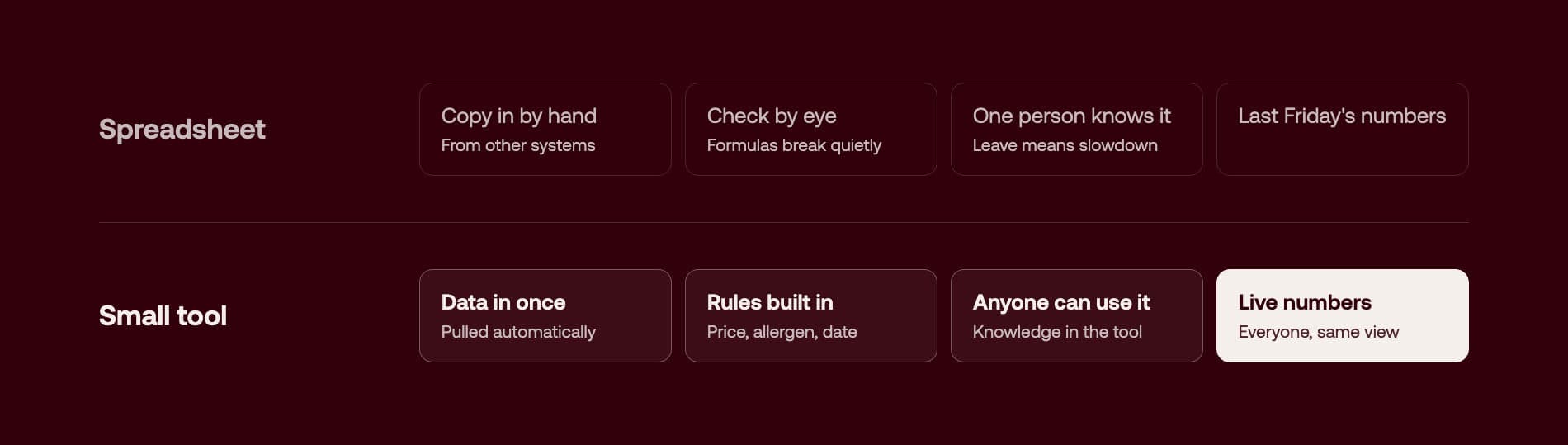
Data goes in once, pulled from the systems you already have instead of copied by hand. The rules are built in, so the tool checks the price, the allergen or the date, not the person. Anyone can use it, because the knowledge lives in the tool rather than in one person's head. And everyone sees the same live numbers, not last Friday's version.
If the spreadsheet exists because two systems do not talk, the fix may be connecting them rather than building anything new. And if the real problem is that the spreadsheet keeps losing to the day job, we wrote about that in It lost to the day job.
Do the sum this week
Pick the spreadsheet your business would struggle without. Then work out three things: the hours per week spent keeping it running, the last mistake it caused and what it cost, and who you would call if it broke tomorrow.
If the first number is more than a few hours, or the third answer is one person, it is worth a conversation.


