
Most manufacturers we meet are not short of data. Their machines log cycle times, stoppages, temperatures and counts every few seconds. Some of them paid a lot to get it.
Then we ask the shift supervisor what they look at to run the shift. The answer is almost always a whiteboard, a walk of the floor, and a gut feel.
The data is there. It just never gets to the person who could act on it, in a form they can use, at the moment it matters.
The dashboard nobody opens
The usual fix is a dashboard. It has 30 charts, an OEE score, and a trend line for every machine. It looks great in the boardroom on a Monday.
On the floor at 10pm it is useless. The supervisor does not need to know that availability was 78% last week. They need to know which machine to walk to right now, and why.
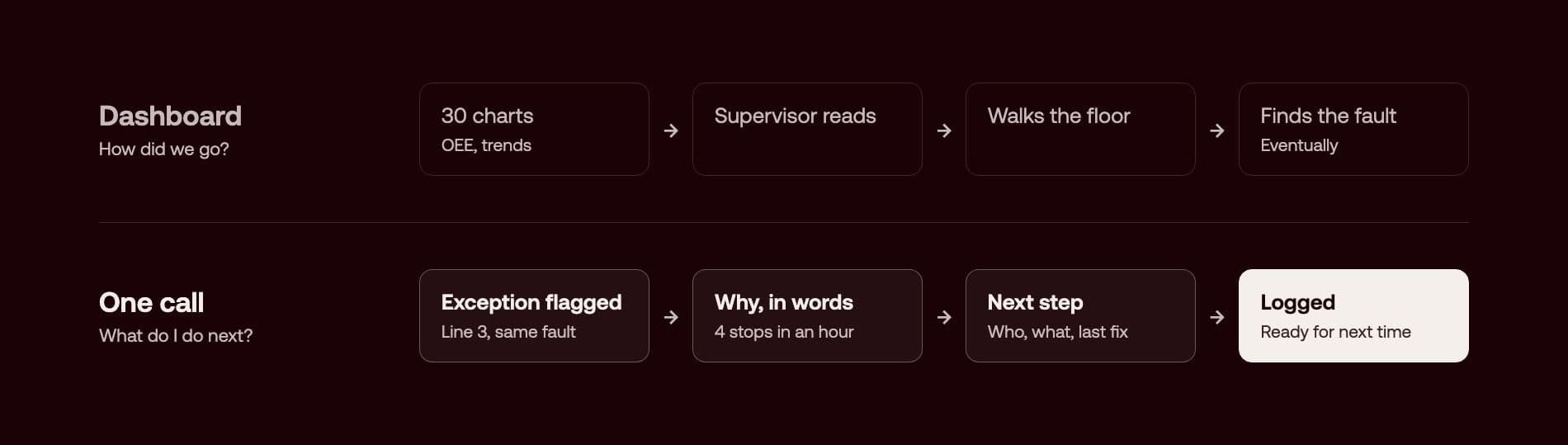
A dashboard answers "how did we go?" A supervisor needs "what do I do next?"
One call per shift
The best tools we have built for production teams do less, not more. They are designed around a single question: what is the one thing this person should act on right now?
That changes the design. Lead with the exception: show the machine that is off its normal pattern, not every machine that is fine.
Say why in plain words. "Line 3 has stopped four times in an hour, all on the same fault" beats a red dot. Then give the next step: who to call, what to check, what fixed it last time.
Finally, close the loop. The supervisor taps what they did, and next time the same fault shows up, that answer is waiting.
That last point is where the value builds. Every shift adds to what the system knows about your floor.
Where AI fits, and where it does not
This is a good job for AI, with limits. A model is good at spotting a pattern across thousands of readings and turning it into a sentence a person can read. It is good at finding the note from three months ago that matches tonight's fault.
It should not be stopping your line on its own. It flags, explains and suggests. The supervisor decides. Keep the person where the risk is, and people will trust the tool enough to use it. We wrote more about this in AI readiness is the real work.

What it is worth
Put a number on it before you build anything. Work out what an hour of unplanned downtime costs you on your busiest line. Then count how long it takes today, from a fault starting to someone fixing it.
If a supervisor gets to the right machine 20 minutes sooner a few times a shift, the maths usually does the arguing for you.
Where to start
Pick one line, the one where downtime costs you most. Ask the supervisor what they wish they knew sooner, because that is your first screen. And use the data you already have. You rarely need new sensors, just the data you have in a form someone can act on. An AI Readiness Assessment is a quick way to find out which line to start on.
Start small, prove the hours saved, then roll it out to the next line.


