

Almost every strategy workshop I sit in ends the same way. Someone writes the problem on the whiteboard, the room talks for an hour, and the answer at the bottom says "use generative AI".
That is not an answer. That is a tool looking for a job.
We have done this before
In 2012 every business needed an app. In 2016 it was blockchain. In 2019 it was IoT sensors on everything. Each time, the question in the room was "what can we do with this?" instead of "what is actually costing us money?"
AI is the same pattern with a better demo. A language model can write a convincing email, summarise a 40-page contract, or answer questions about your product catalogue. It is genuinely useful. It is also just software. It reads text, it predicts text, and it is wrong some of the time.
Treat it like that and you will make good decisions. Treat it like magic and you will buy a prototype and call it a product.
The prototype trap
Here is how it usually goes. A team spends two weeks building a chatbot on top of the company's documents. The demo is great. Everyone is excited.
Six months later, nobody uses it. Not because the AI is bad. Because nobody asked who the user was, what they were trying to do, or why they were not doing it already. The answers were in the documents all along. The real problem was that the documents were out of date and nobody owned them.
A faster way to search stale information is still stale information.
The boring work is the real work
The projects that actually pay off rarely look impressive. They look like this:
- A quoting process that took two days now takes two hours, because we connected the CRM to the pricing sheet and let a model draft the first version.
- A job-costing report that someone rebuilt by hand every Friday now builds itself.
- An invoice-matching task that ate one person's whole Monday now flags the three exceptions that need a human.
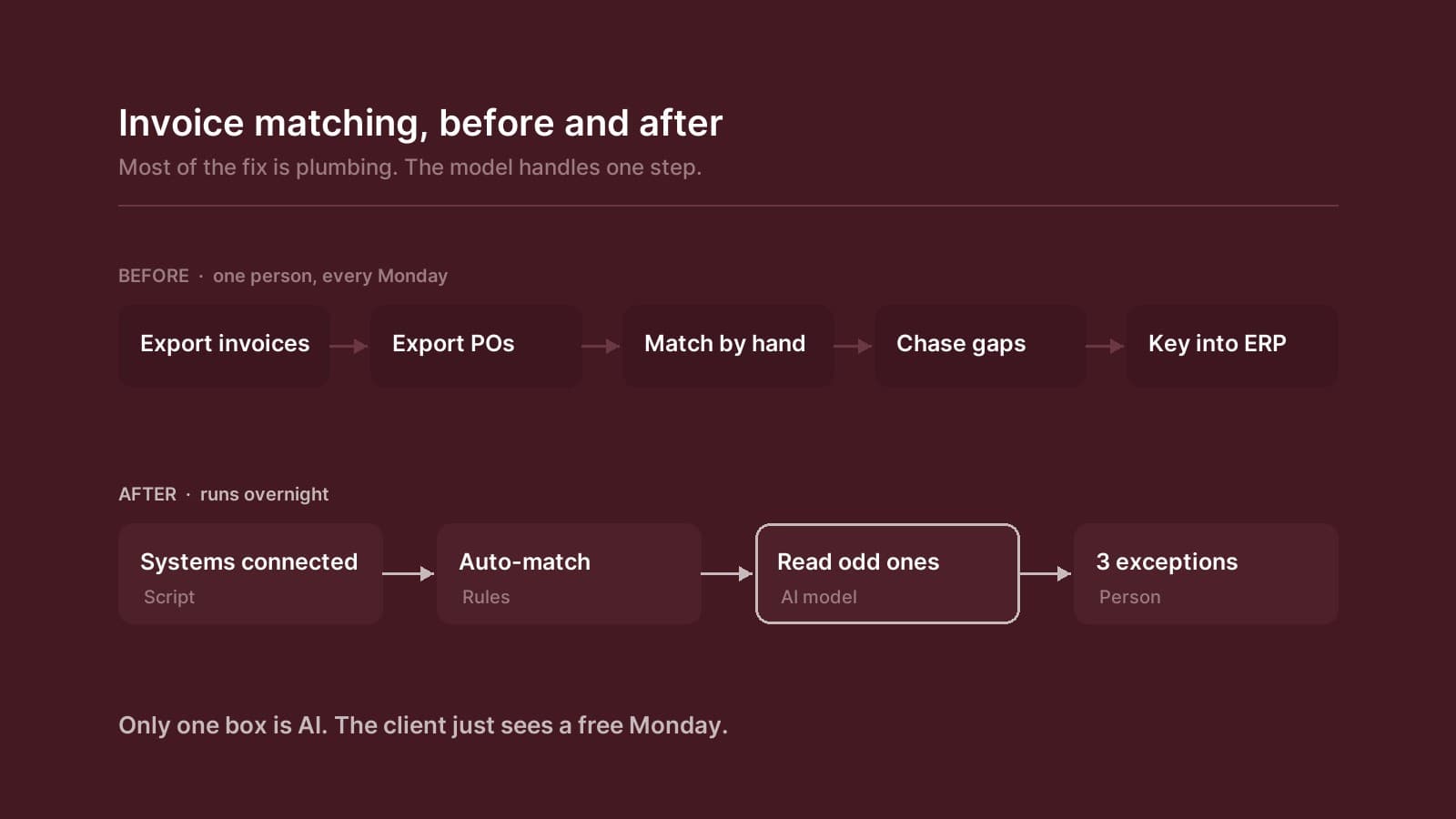
Some of those use AI. Some of them use a database and a scheduled script. The client does not care which. They care that Monday is free.
That is the point. The value came from joining together technology we already had, cheaply and reliably, around a problem someone could name. The model was one part of it, not the headline.
"The AI did it" is not an excuse
There is another reason to keep AI in its box. When it is treated as something mysterious, it becomes easy to hide behind. A bad decision gets blamed on "the algorithm". A process nobody designed gets called "emergent".
It is your system. You chose what it reads, what it is allowed to do, and who checks the output. If it gets something wrong, that is a design decision, and it can be fixed like any other.
Start from the other end
So flip the question. Do not ask what AI can do for your business. Ask:
- Where do we lose the most time or money every week? Put a number on it.
- Who does that work today, and why is it slow? Watch them do it.
- What is the simplest thing that would fix it? Sometimes that is a model. Often it is a form, a rule, or one system talking to another.
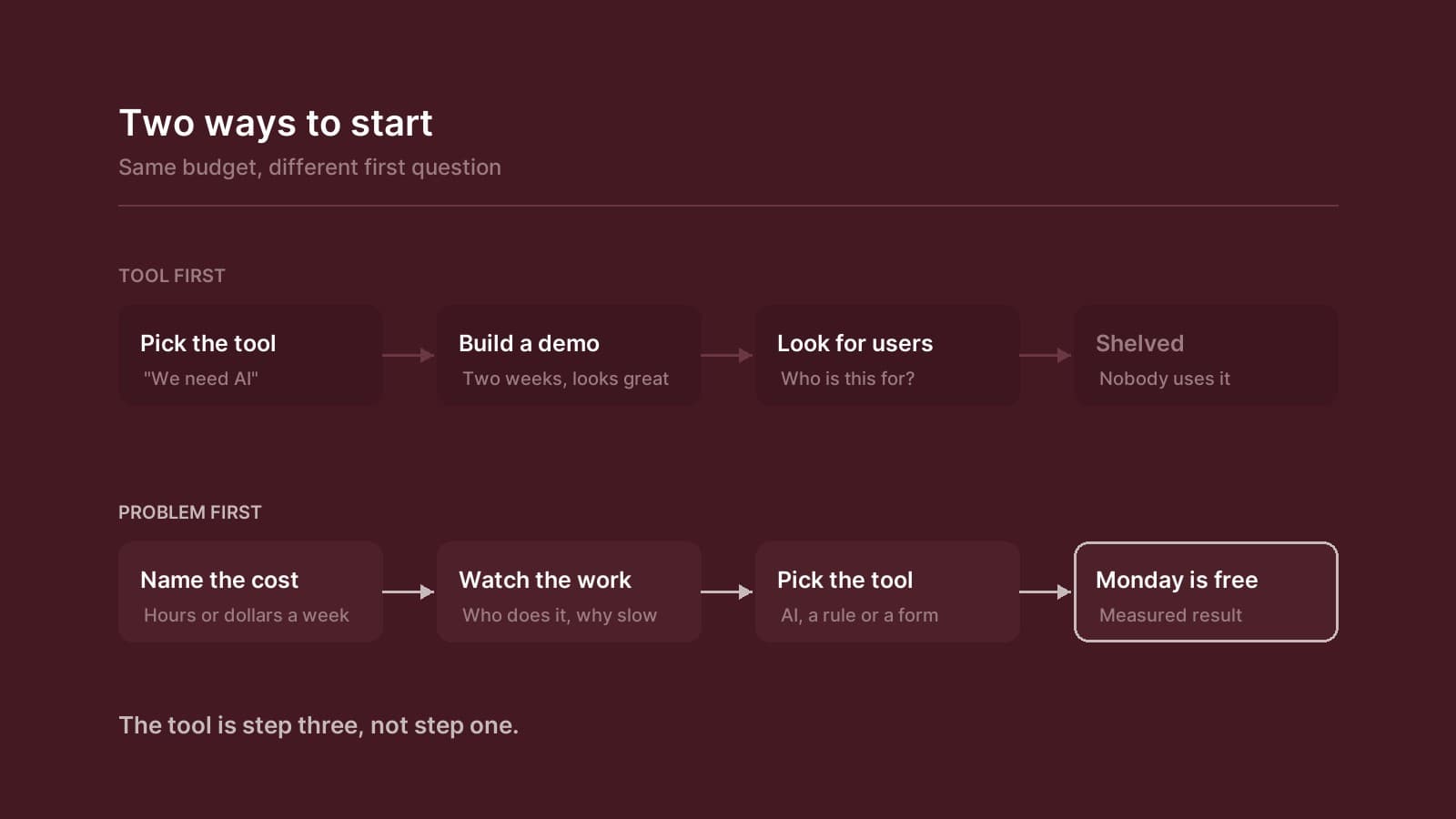
If AI is the right tool once you get to that last question, great. Use it properly, test it, and put a person where the risk is. If it is not, you just saved yourself a very expensive demo.
A good strategy never has the solution baked into it. Ours starts with the problem, and it stays there until we have earned the right to pick a tool.


